
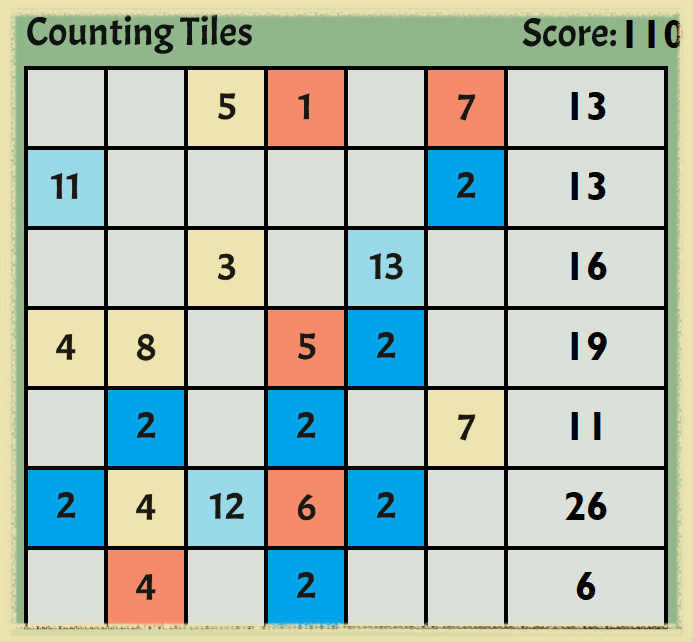
The gameboard automatically starts with seven tiles placed. To achieve row values of 21, tiles can be placed on the gameboard, moved, or combined with each other. Each time a tile is placed, a randomly-generated tile is placed in an open space on the board.
The currently-drawn tile appears adjacent to the gameboard. This tile can be placed in any open space on the board. Once placed, a new tile is drawn.
Tiles can be moved to an adjacent square (not diagonally), but each tile can only be moved once. When a tile is moved, the currently-drawn tile is automatically discarded and a new tile is drawn.
Tiles can be combined with adjacent tiles of lower values by which they are evenly divisible. As a result of combining, the tile being combined takes on the quotient value of the combining operation. For example, tile A has a value of 10 and tile B has a value of 5. Tile A can be combined with tile B. Tile A now reflects the quotient value of 2. Once tiles are combined, they cannot be moved or combined any further. A combined tile, however, can be still used as the tile by which a tile of larger value is divided. When a tile is combined, the currently-drawn tile is automatically discarded and a new tile is drawn.
For a row to be completed, it must be completely filled and the sum of the tile values in the row must be exactly 21. When a row is completed, the tiles in the completed row are cleared and a bonus is unlocked. The bonuses can be used at any time in future gameplay and they unlock from top to bottom. If the first bonus goes unused, the second bonus gets unlocked when the next row is completed. Once unlocked, the bonuses can be used in any order.